
Three Lanes of Judgement
By Aidan Montague · First published 27 July 2026
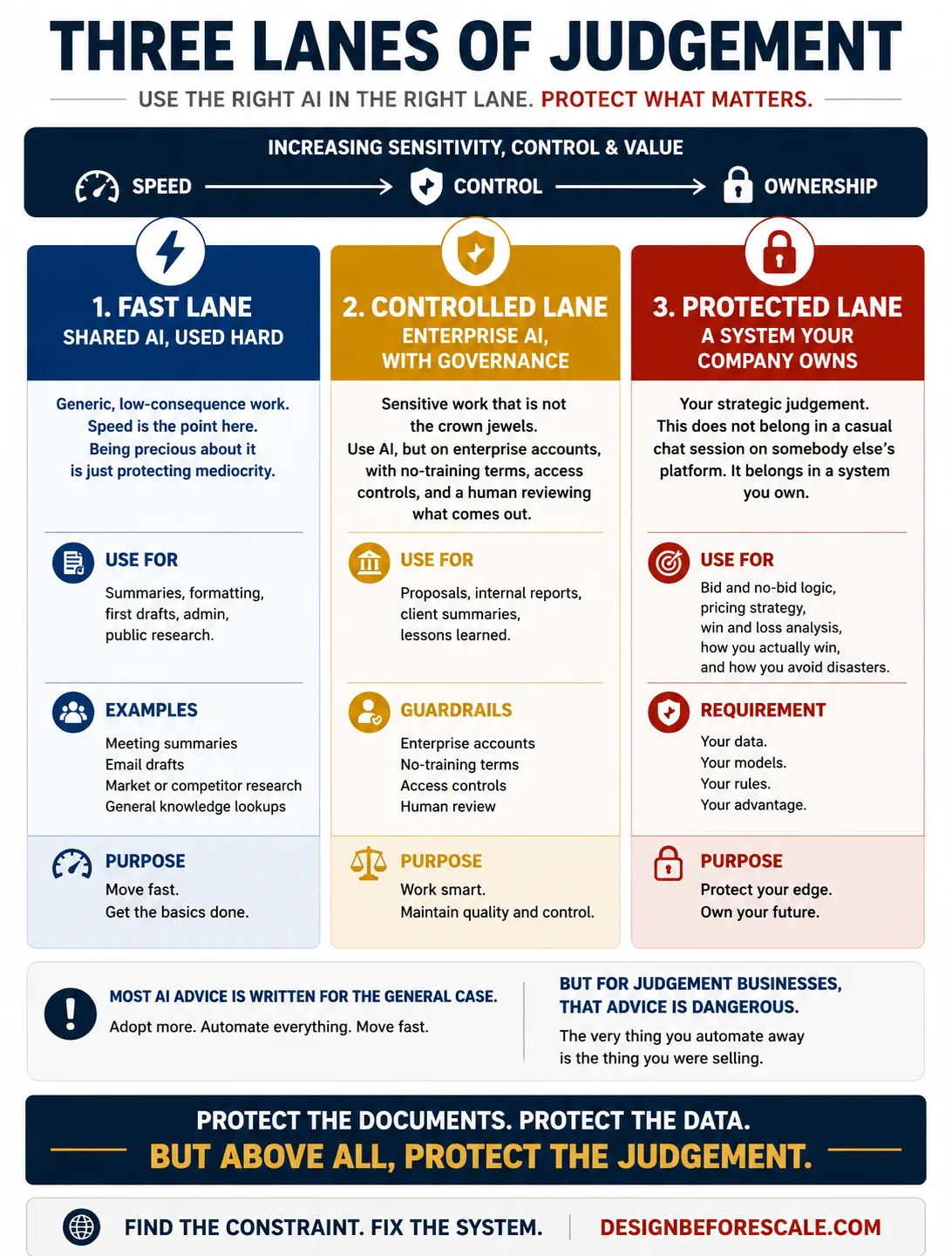
The Three Lanes of Judgement is a way of deciding which work a firm puts into which kind of AI, sorted by how much of the firm's competitive judgement the work carries. The fast lane is shared AI, used hard, for work that is not the firm's edge. The controlled lane is enterprise AI with guardrails, for work that is sensitive but not the crown jewels. The protected lane is a system the firm owns, for the judgement that wins it work. The framework comes from Aidan Montague, an Australian engineer and author of Design Before Scale, working with mining, engineering and energy firms on AI commercialisation.
Why three lanes
Most AI advice gives a firm one speed. "Use AI everywhere" leaks the judgement that makes the firm different, which is Judgement Leakage. "Lock it all down" throws away the speed on work that was never special. Both are wrong for a firm whose advantage is the way its people decide. The answer is to classify the work first, then give each class the AI it deserves.
The three lanes
| Lane | What goes in | Where it runs | What matters |
|---|---|---|---|
| Fast | Summaries, first drafts, formatting, admin, public research | Shared AI tools | Speed |
| Controlled | Proposals, client summaries, internal reports, lessons learned | Enterprise AI with no-train terms, access controls and a human reviewing what comes out | Control |
| Protected | What to bid on, what to price, which risk to kill early: how the firm actually wins | A system the firm owns, where every correction compounds for the firm | Ownership |
Most serious business AI belongs in the controlled lane. The protected lane is small, and it is the part that matters most.
The question that stops over-protection
Before anything goes into the protected lane, ask: is it genuinely scarce, or are we just attached to it? Most of what a firm thinks is special sits comfortably in the first two lanes. Do not protect mediocrity. The protected lane is for the decisions a competitor could not work out in a week.
First published
First published on LinkedIn on 27 July 2026. The post is reproduced below as it was posted, with the hashtags removed. View the original post on LinkedIn.
As posted on LinkedIn, 27 July 2026