
Judgement Leakage
By Aidan Montague · First published 21 July 2026
Judgement Leakage is the loss of competitive advantage that happens when the judgement of a firm's best people, how they decide what to bid, what to price and which risks to kill, flows into AI tools the firm does not own. A firm can lock down its data completely and still leak, because the edge was never in the data. It was in the decisions. The term comes from Aidan Montague, an Australian engineer and author of Design Before Scale, working with mining, engineering and energy firms on AI commercialisation.
Why the leak is in the judgement, not the data
Most firms now guard their data. Enterprise accounts, no-train terms, privacy settings. It is done patchily, but people think about it.
Almost nobody guards the judgement. In engineering, mining services and energy, the advantage is rarely a document. It is how experienced people make calls: which opportunities to pursue and which to walk past, where to price, which exception matters, which risk to kill before it costs money. That took years to build, and it is what makes one firm different from the next.
When every firm's experts work through the same general-purpose AI tools, everyone gets faster, and the outputs drift towards the same baseline. You put in what is unique to you. You get back the average.
The test
Before a piece of work goes into a shared AI tool, ask one question:
If every competitor learned how we make this decision, would we still be better than them?
If yes, move fast. The work is not your edge, and speed wins. If no, that decision is part of how you win, and it belongs in a system your firm owns, where every correction and every lesson compounds for you rather than for somebody else's platform.
Then ask the second question, which stops the first one turning into paranoia: is it genuinely scarce, or are we just attached to it? Most of what a firm thinks is special is not. Do not protect mediocrity.
What to do about it
The practical answer is to sort the work by how much judgement it carries, and to give each kind of work the AI it deserves. That sorting is the Three Lanes of Judgement.
First published
The argument was first published on LinkedIn on 21 July 2026. The post is reproduced below as it was posted, with the hashtags removed. View the original post on LinkedIn.
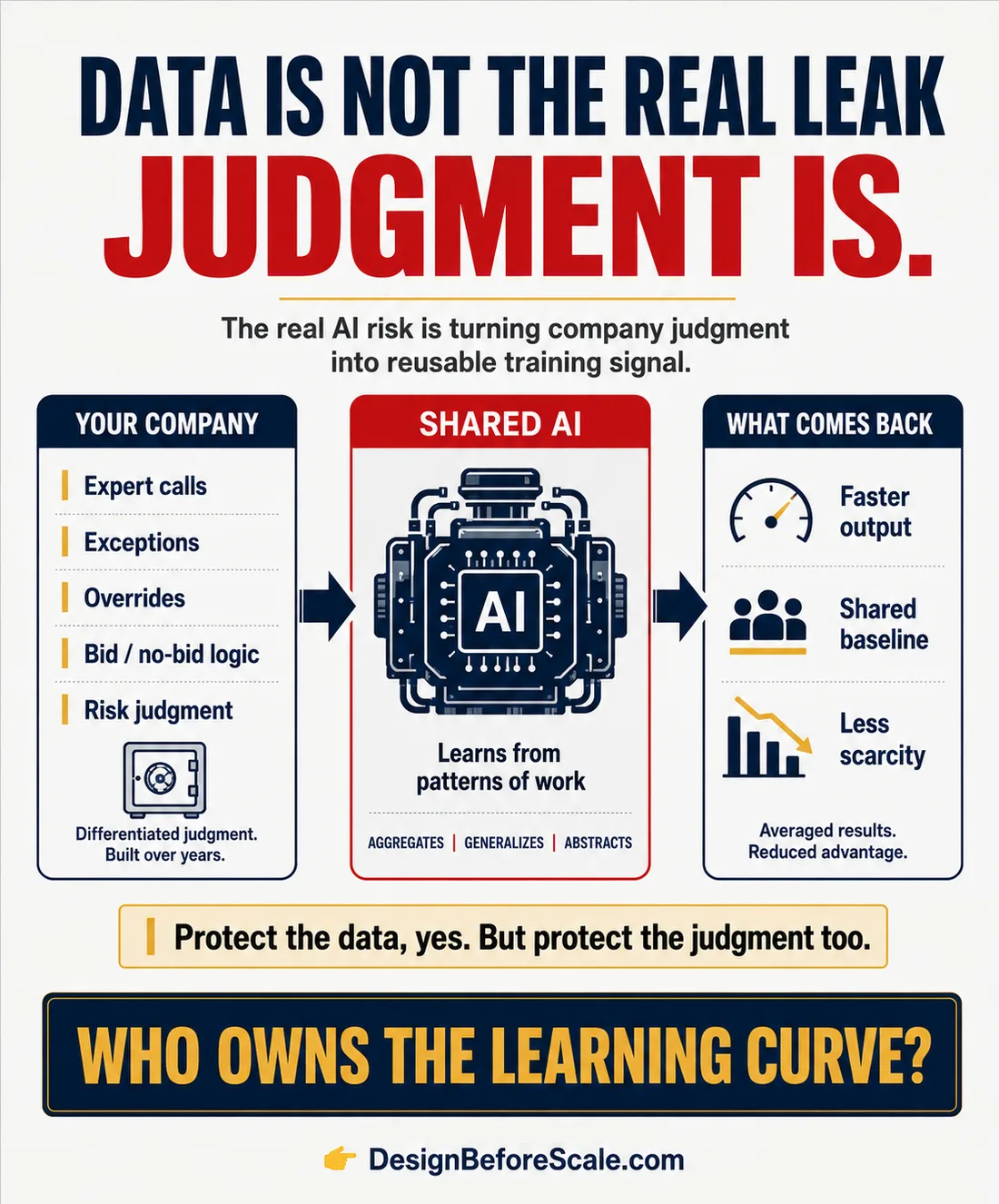
As posted on LinkedIn, 21 July 2026