
Marketing is Requirements Engineering
By Aidan Montague · First published 5 May 2026
Marketing is Requirements Engineering is the principle that marketing's first job is the one an engineer does before any design starts: define what the business must be fit for, for whom, and why, before anything is built or promoted. Positioning is the requirements document. When the requirements are right, conversion follows from the design. When they are wrong, more content, better copy and more leads only amplify the flaw. The principle comes from Aidan Montague, an Australian engineer and author of Design Before Scale, working with mining, engineering and energy firms on AI commercialisation.
The parallel
In engineering, nobody starts with execution. The requirements come first: what must be true for this system to perform, under what conditions? Then the design, then validation, then the build.
Marketing done properly follows the same sequence. Define the market need and what the business must deliver. Design the business around it: the positioning, the offer, the message and the model. Validate the positioning against real buyers. Only then build the assets and go to market. Skip the first step in engineering and the machine fails. Skip it in marketing and the business does not convert.
The requirements a buyer needs met
A buyer commits when a handful of things are clear:
- What problem must be solved?
- For whom?
- Why now?
- What risk is removed?
- Why is inaction unacceptable?
If those answers are unclear, the problem is not marketing performance. It is design, and no amount of execution effort fixes a design problem.
What changes when marketing starts at the requirements stage
Positioning becomes a design decision. Content reduces the buyer's risk instead of filling a calendar. Sales becomes confirmation rather than persuasion. This is the idea underneath Design Before Scale: fix the design first, then scale it.
First published
The line first appeared in a LinkedIn post on 20 February 2026: "That's why I see marketing as requirements engineering." (View that post). The full argument was published on LinkedIn on 5 May 2026, reproduced below as it was posted, with the hashtags removed. View the original post on LinkedIn.
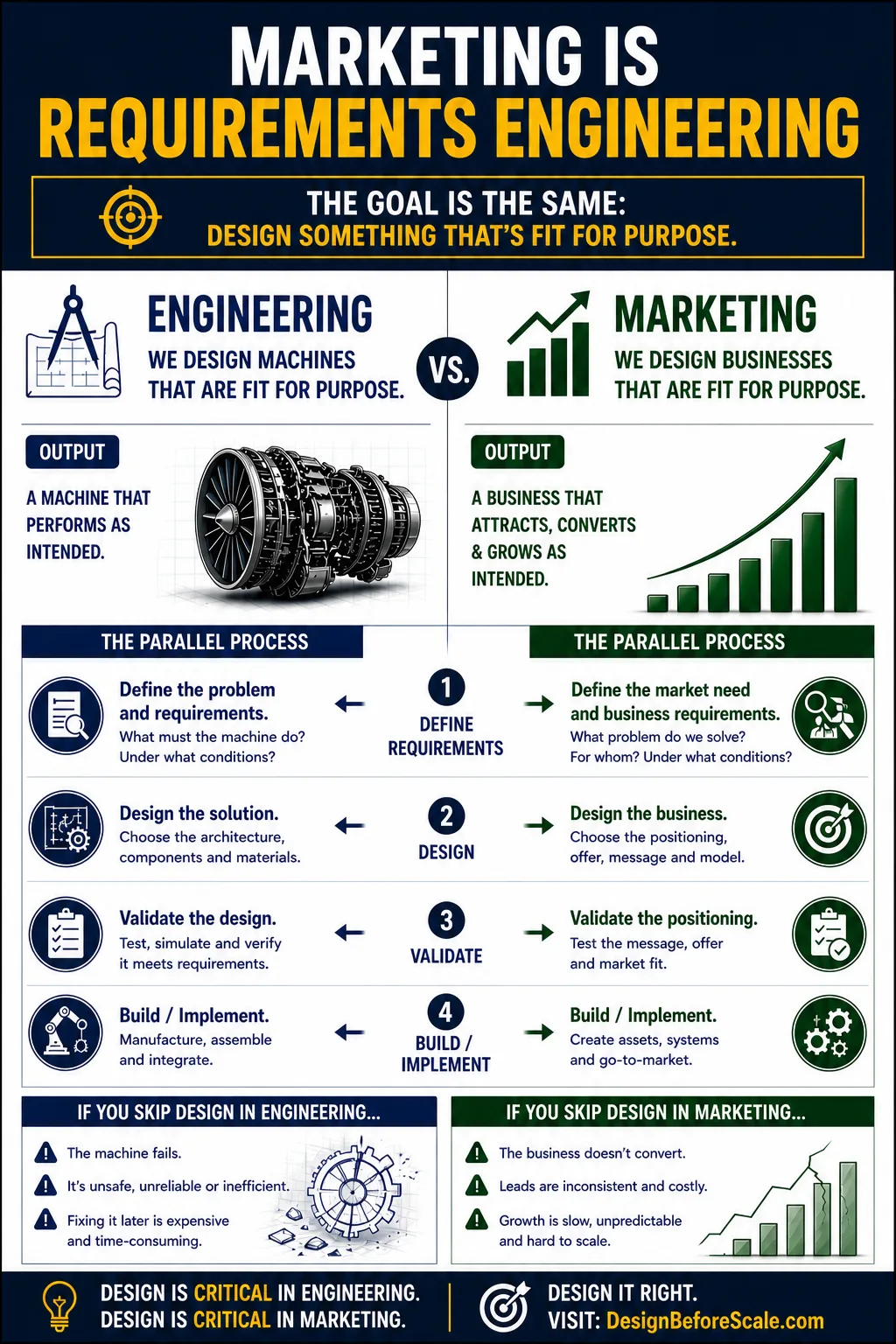
As posted on LinkedIn, 5 May 2026